


One input, five outputs, and a clear distinction between physical wiring and the EtherCAT topology scan.
Machine devices rarely sit in a straight line. Drives and I/O may be spread across feeding, positioning, processing, inspection, and discharge stations, while a single daisy chain sends cables back and forth across the equipment.
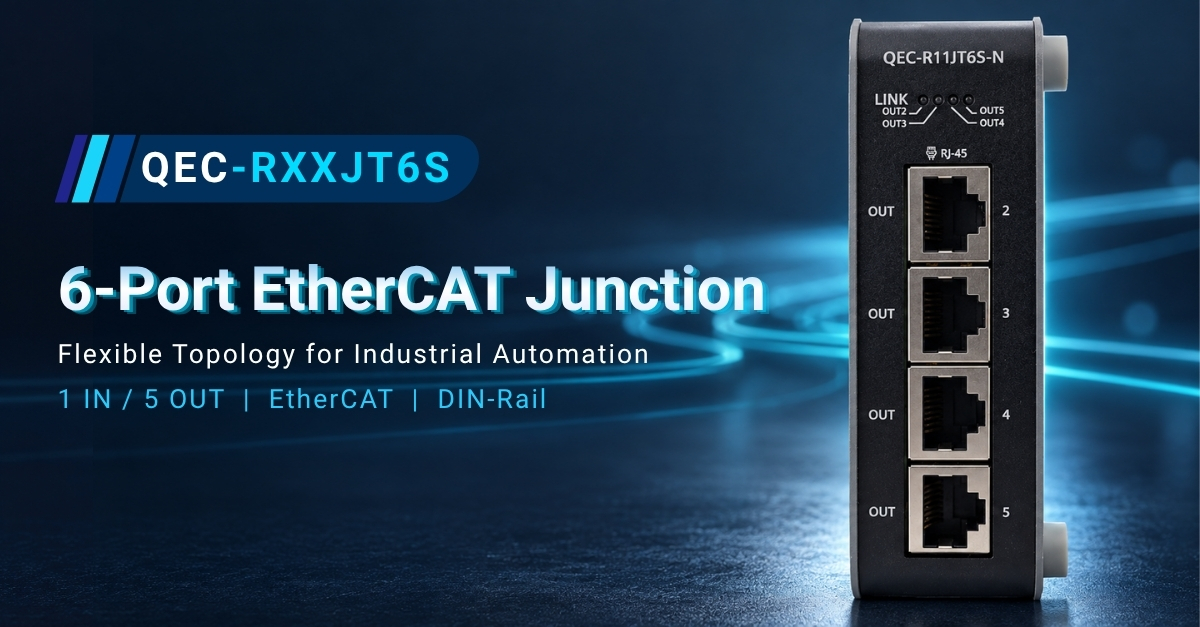
ICOP Technology's QEC-RXXJT6S gives machine builders a practical way to route EtherCAT connections by station. The junction provides one incoming RJ45 port and five outgoing RJ45 ports, allowing line, star, and tree layouts within the same machine.
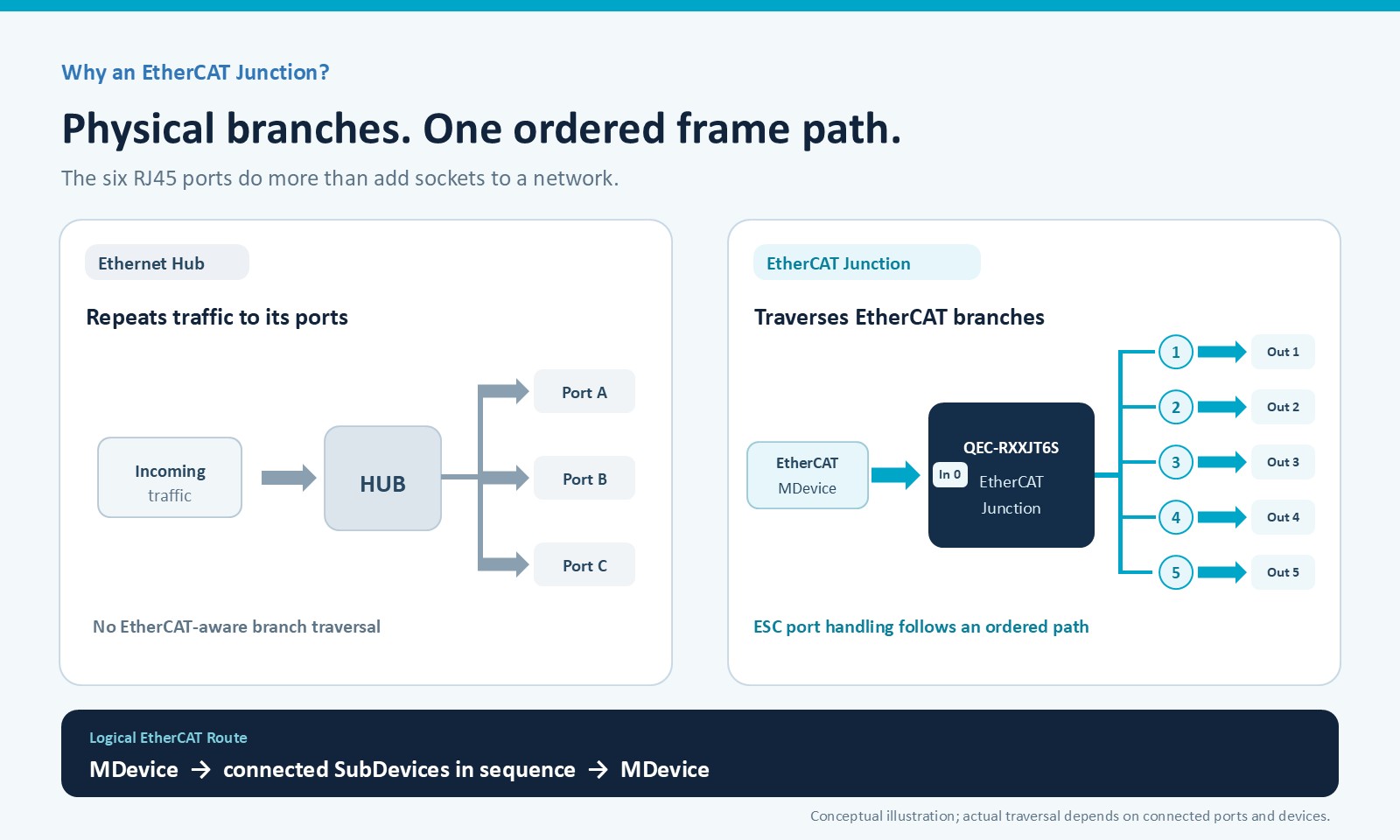
The six RJ45 connectors can resemble those of a network hub or switch, but the QEC-RXXJT6S has a different job. A conventional Ethernet hub repeats traffic across its ports. An EtherCAT junction is part of the EtherCAT network: its EtherCAT Slave Controllers (ESCs) handle the branch ports while the frame follows an ordered logical path through the connected SubDevices and returns toward the MDevice. The physical cables can branch to different areas of a machine while remaining in one EtherCAT topology.
This is the junction's value on a machine floor: engineers can place branch connections near the equipment they serve without treating those ports as general-purpose Ethernet outlets.
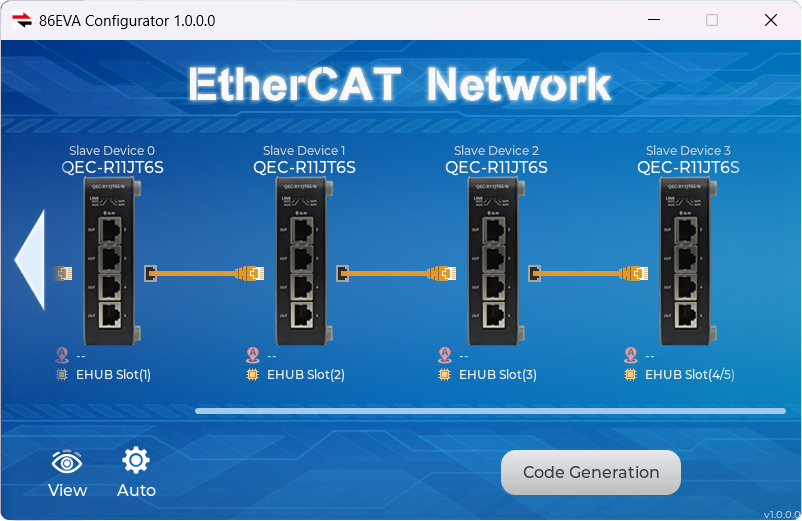
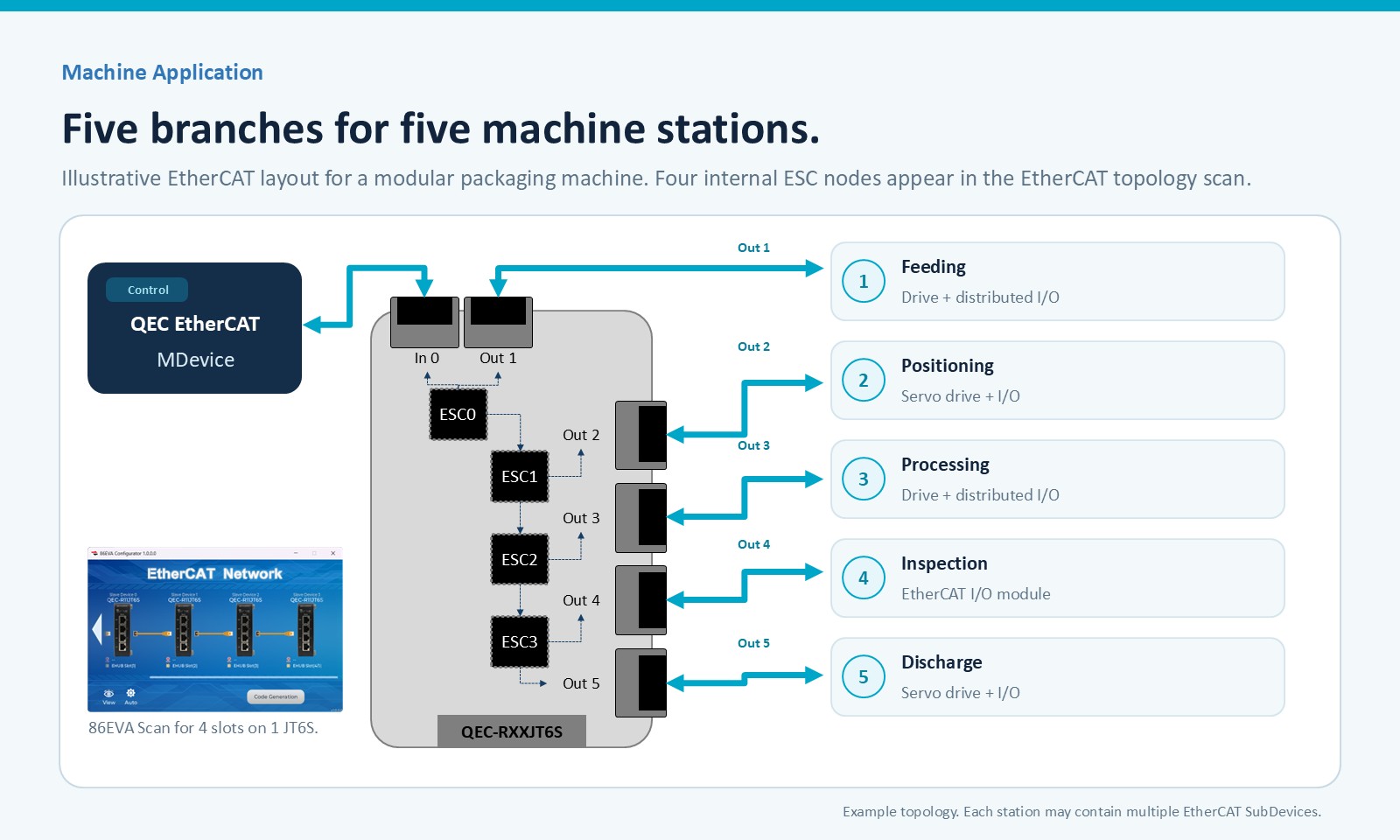
The QEC-RXXJT6S has five OUT ports for connecting machine stations. Inside the JT6S, four ESCs make up the junction's internal EtherCAT path. In an EtherCAT topology scan, those four ESCs appear as four JT6S SubDevices. The four scanned SubDevices describe the junction's internal topology; they are not a count of its outgoing connectors.
The wiring diagram and the scan therefore show two views of the same module: five physical OUT branches and four internal EtherCAT nodes. The port assignments are ESC0 for IN and OUT1, ESC1 for OUT5, ESC2 for OUT4, and ESC3 for OUT2 and OUT3. These assignments also help engineers read the topology scan alongside the physical wiring.
Consider a packaging machine with feeding, positioning, processing, inspection, and discharge stations. Each station can take one of the junction's five outgoing branches, with its drives and distributed EtherCAT I/O connected along that branch.
A branch can continue as a daisy chain where the machine layout calls for it. This makes cable routes easier to plan and gives maintenance teams a clear physical starting point when checking a station's connection.
The QEC-RXXJT6S supports EtherCAT over 100BASE-TX with connection lengths up to 100 m per copper link. It requires no additional module configuration, supports a reference clock, and has been verified with the EtherCAT Conformance Test Tool. For installation, it accepts a +19 to +50 VDC input, consumes 0.5 W, operates from −20°C to +70°C, and mounts on a DIN rail. Power, RUN, error, and link indicators help technicians check status at the module.
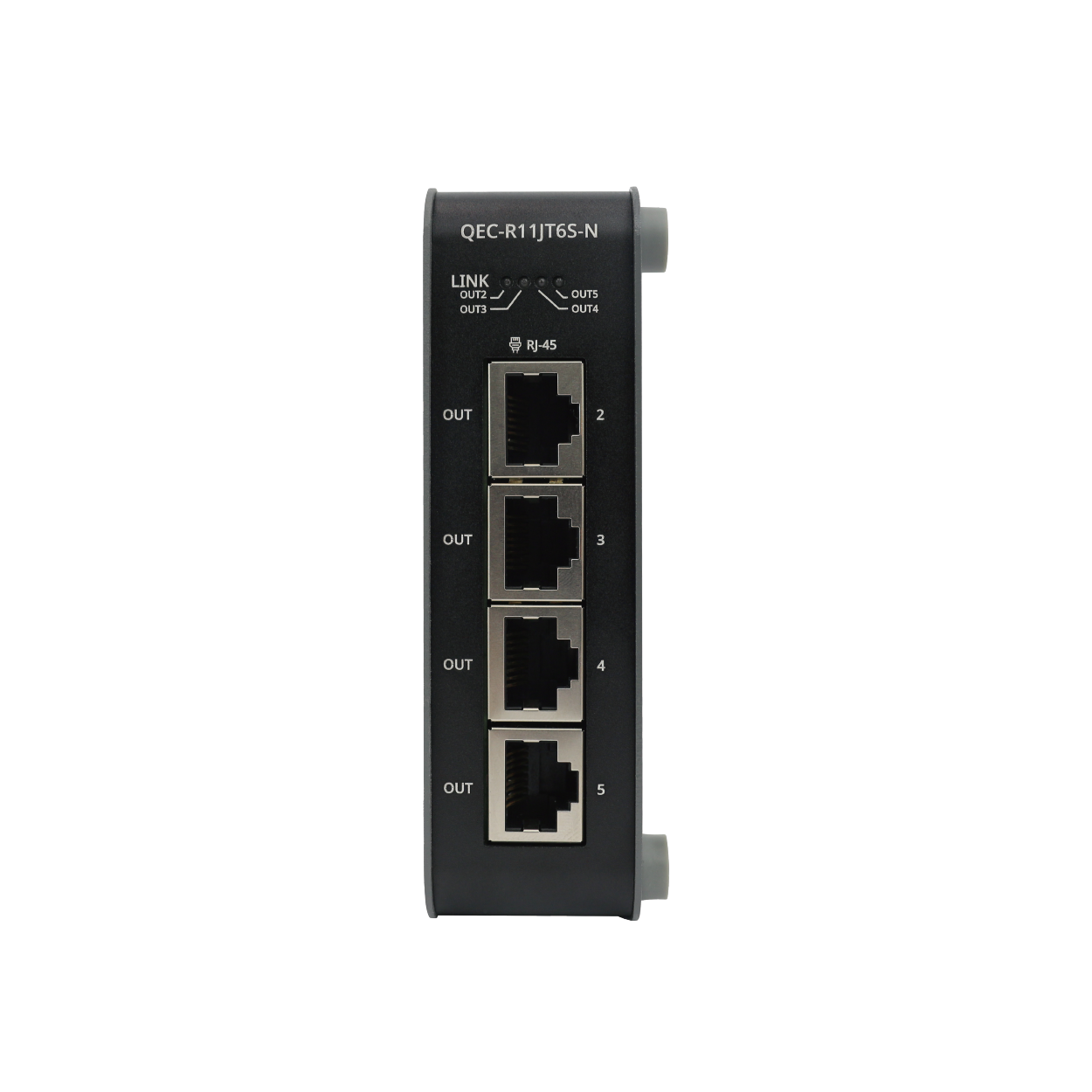
The QEC-RXXJT6S-N helps machine builders plan EtherCAT wiring around the equipment they are building, from compact multi-station machines to distributed automation systems.
For specifications and ESI resources, visit the QEC-RXXJT6S product page. For more info and sample request, please write to info@icop.com.tw, call your nearest ICOP Branch, or contact our Worldwide Official Distributor.