


As machines become more connected, machine builders increasingly face a practical networking challenge:
The machine network and the factory network often serve very different purposes.
At the machine level, controllers, I/O modules, drives, and sensors may exchange data over a dedicated network using protocols such as Modbus TCP. At the factory level, SCADA, monitoring, or data acquisition systems may require OPC UA over a separate plant network.
The data needs to move between these two environments — but the networks themselves do not necessarily need to be directly connected.
For a conventional system, this may mean adding an industrial computer or protocol gateway along with additional networking equipment. The QEC-PPC-M-090T-S provides a more integrated approach by combining a programmable HMI Panel PC with two independent Ethernet interfaces.
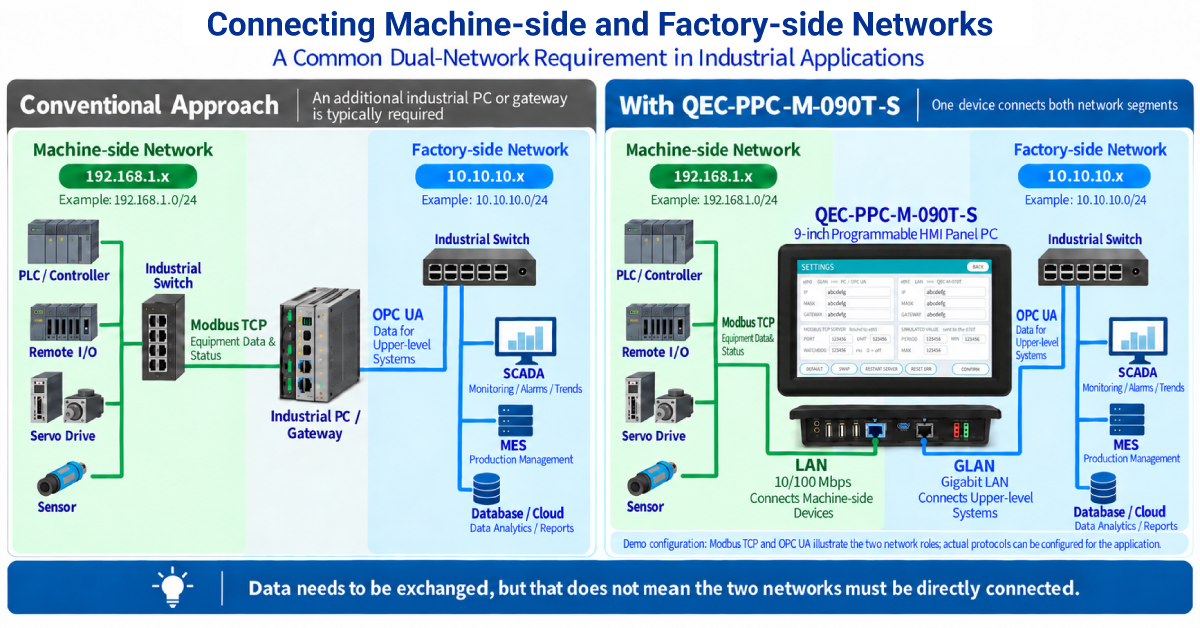
The diagram above illustrates the key difference: instead of adding separate devices between the machine and factory networks, the QEC-PPC-M-090T-S can sit directly between the two environments while providing the local HMI at the same time.
The QEC-PPC-M-090T-S is more than a local operator interface. With two independent Ethernet interfaces, it can exchange data with the machine-side controller through Modbus TCP and provide selected data to factory-side SCADA or upper-level systems through OPC UA, while keeping the two network segments independent.
The QEC-PPC-M-090T-S provides two independent Ethernet interfaces that can be assigned to different network roles:
The value of the dual-Ethernet design is not simply having an additional network port. It allows machine-side communication and factory-side connectivity to be configured on separate network segments according to the application architecture.
In the demonstrator described in this article, Modbus TCP and OPC UA are used to illustrate the two Ethernet network roles. They are application examples rather than fixed assignments for the interfaces; developers can select the communication methods and data flow according to the requirements of their own system.
At the same time, developers can use 86Duino IDE to build the application in C/C++, defining how communication, data mapping, and application logic operate between the two sides.
Dual Ethernet connects two different network roles; 86Duino IDE lets the developer decide how data is exchanged and used between them.
The dual-network architecture is supported by hardware designed for installation at the machine site. The QEC-PPC-M-090T-S uses a fanless design, helping reduce fan maintenance and the active intake of airborne dust associated with forced-air cooling.
Its IP65-rated front panel helps protect the operator-facing display and touchscreen against dust and water when the unit is properly installed in a panel or control cabinet. The IP65 rating applies to the front panel, not the entire enclosure.
For environments subject to temperature changes, the standard operating temperature range is 0°C to +60°C, with an optional extended-temperature configuration of -20°C to +70°C. Together, these features allow the QEC-PPC-M-090T-S to serve not only as an integrated HMI and protocol gateway, but also as an industrial Panel PC suited for direct deployment on machinery.
The key idea behind this dual-network architecture is simple: bridge the data, not the networks.
The QEC-PPC-M-090T-S does not operate as a transparent network bridge between the machine and factory networks. Each Ethernet interface can maintain its own network role, while the application determines what information crosses the boundary.
Machine data received through Modbus TCP can be processed and selectively mapped into OPC UA variables for the factory-side system.
The data can be exchanged while the two network segments remain separate.
For machine builders, this provides a practical way to keep machine communication focused on equipment operation while providing the information required by SCADA or factory-level applications.
It can be especially useful when connecting existing equipment to a plant network without redesigning the original machine-side network architecture.
To show how this architecture works in practice, a working demonstrator was built around the QEC-PPC-M-090T-S rather than treating dual Ethernet as a theoretical feature.
In this setup, the QEC-M-070T remains the machine-side EtherCAT controller. It gathers I/O data from an R11CFFG EtherCAT I/O module and a Modbus RTU I/O board, then exchanges process data and commands with the QEC-PPC-M-090T-S over Modbus TCP on the machine-side network.
On the factory side, the QEC-PPC-M-090T-S provides selected data through an OPC UA server, allowing an OPC UA client such as UaExpert or a SCADA system to monitor the machine from the factory network.
The data path in the demonstrator is:
Machine I/O → QEC-M-070T → Modbus TCP → QEC-PPC-M-090T-S → OPC UA → Factory-side Client
The flow is bidirectional. Machine status and process data move upward to the factory-side client, while permitted commands can be validated and passed back toward the machine controller.
The important point is that the QEC-PPC-M-090T-S is not simply forwarding network packets. In the demonstrated application, it acts as the local operator panel, protocol bridge, and network boundary, while the QEC-M-070T continues to handle machine-side EtherCAT control.
This working setup makes the dual-network concept visible in an actual application: the operator can view machine status locally on the QEC-PPC-M-090T-S, while selected machine data is simultaneously available to the factory-side system.
A fixed-function gateway can translate data between protocols, but a connected machine often needs more than protocol conversion.
The operator still needs to see machine status, adjust parameters, monitor communication, acknowledge alarms, and understand whether a command has actually been accepted by the machine.
With the QEC-PPC-M-090T-S, communication logic and HMI visualization can be developed on the same platform. Developers can use 86Duino IDE to build the application logic in C/C++, while 86HMI provides a graphical environment for creating the touchscreen interface.
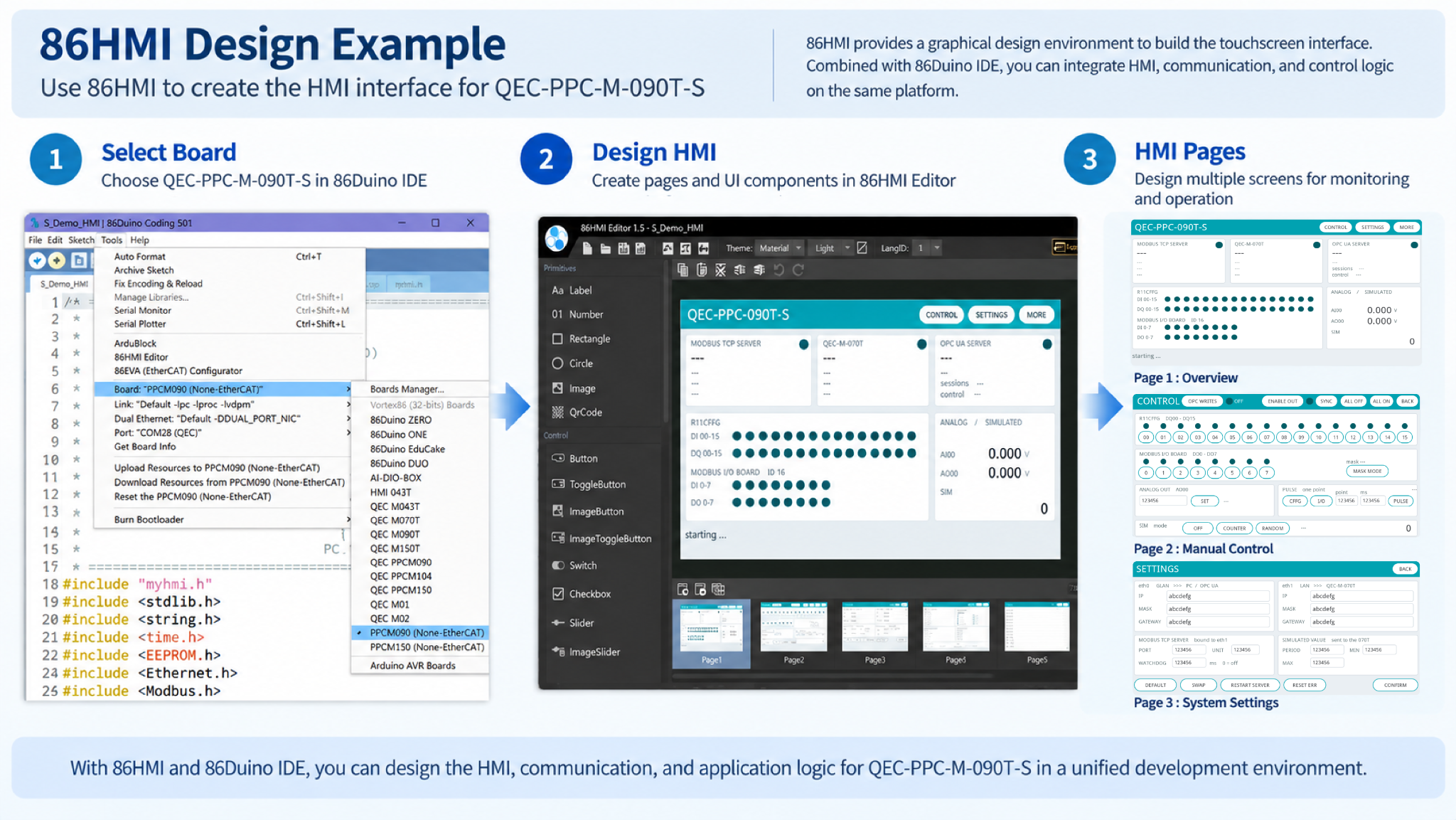
Machine-side data can therefore be used not only for protocol communication, but also for the local operator interface. In this demonstrator, the HMI includes screens for service status and live I/O, manual control, network and protocol settings, diagnostics, and event logging.
At the same time, selected information can be mapped and provided to the factory-side system through OPC UA. The developer can also define application-specific behavior, such as which parameters are read-only, whether remote commands are accepted, and how control authority is handled between the machine controller, local touchscreen, and factory-side OPC UA client.
This is an important distinction from a fixed-function protocol gateway:
The device does not only translate data — it can also present, process, and control how that data is used.
By combining a touchscreen, embedded x86 controller, programmable environment, and dual Ethernet interfaces, the QEC-PPC-M-090T-S can perform several functions within one device:
In the demonstrated system, the QEC-PPC-M-090T-S serves as the operator panel, protocol bridge, and network boundary, while the QEC-M-070T remains responsible for machine-side EtherCAT control.
For applications that would otherwise require an HMI, an additional gateway or industrial computer, and more networking hardware, this integrated architecture can help reduce device count, wiring, configuration, and cabinet space.
This dual-network architecture is particularly suitable for:
For machine builders moving from standalone equipment toward connected manufacturing, the goal is not necessarily to redesign the entire control architecture.
Sometimes, what is needed is simply a better connection between the two sides.
With the QEC-PPC-M-090T-S, the machine network can remain focused on machine communication, the factory network can access the information it needs, and the application determines exactly what passes between them.
For more information and sample request, please write to info@icop.com.tw, call your nearest ICOP Branch, or contact our Worldwide Official Distributor.