cancel

ICOP Validates Control of Oriental Motor OVR 6-Axis Robot Arm Using the QEC EtherCAT MDevice Platform

2026-01-19

As 6-axis robot arm adoption grows, system integrators and OEMs often face complex control, tight synchronization requirements, and HMI–motion integration challenges.

A Practical EtherCAT Architecture and Development Workflow
Enabling System Integrators and OEMs to Accelerate Robot Arm Application Development

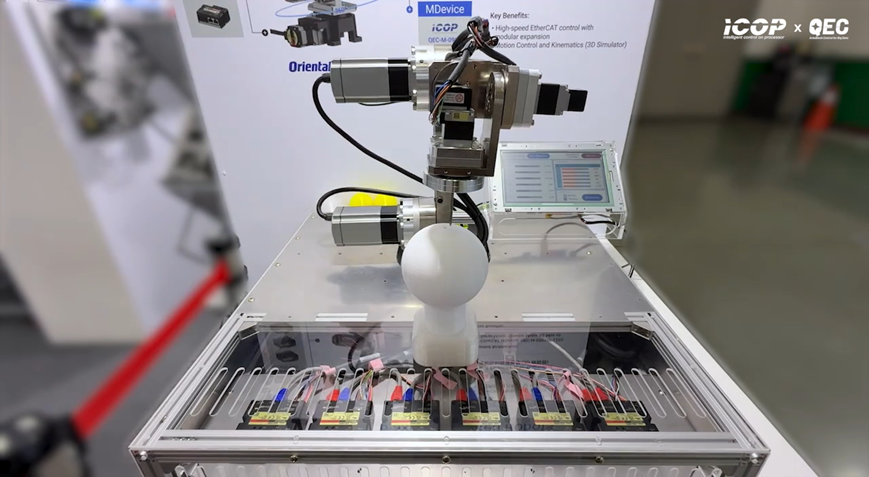
ICOP Technology has recently completed an integration and control validation of the Oriental Motor OVR series 6-axis robot arm using the QEC EtherCAT MDevice platform. This validation demonstrates an EtherCAT-based robot arm control and development architecture that is suitable for real machine deployment, serving as a technical reference for system integrators and OEMs performing secondary development and project integration.
qec+ovr-news

EtherCAT-Based Control Architecture for a 6-Axis Robot Arm

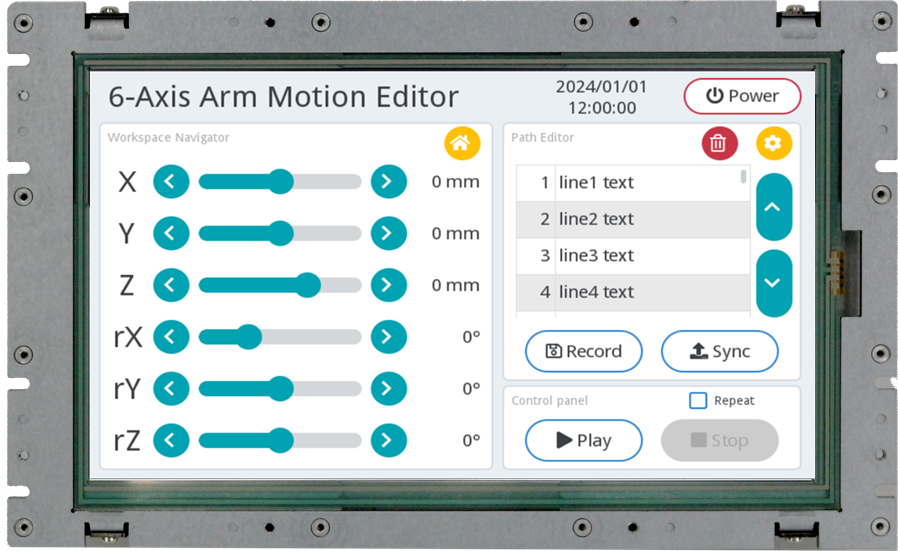
The validated system adopts the QEC-M-090T as an integrated EtherCAT MDevice and HMI platform. Through real-time EtherCAT communication, the controller connects to the OVR 6-axis robot arm drives, forming a single-node Motion + HMI architecture.
Key system components include:
  • Control Core: QEC-M-090T (MDevice + HMI)
    Operating under ECAT_SYNC with Distributed Clocks, the system provides wiring and initial parameter templates, homing procedures, and safety mechanisms.
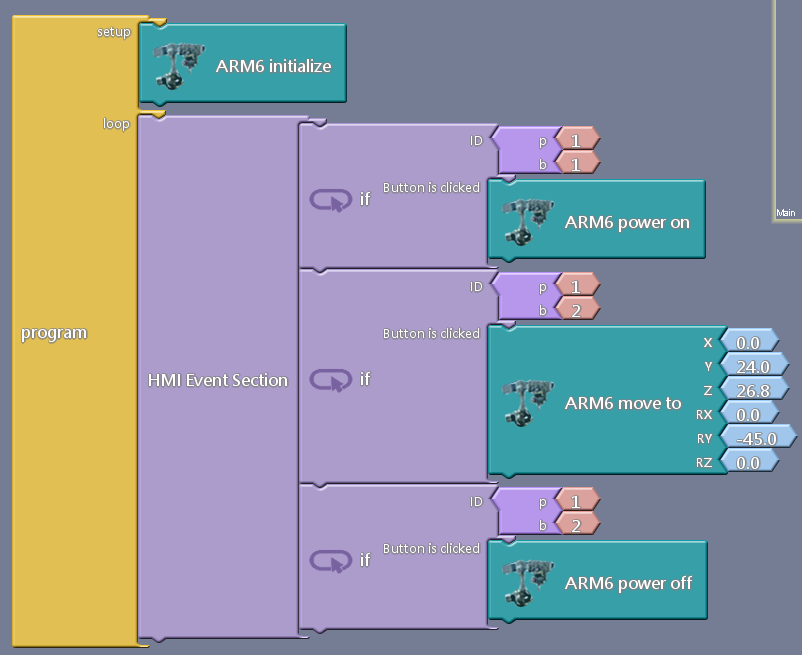
    Built-in ArduBlock and 86HMI enable beginners to rapidly prototype motion behavior and monitor PDO data.
    qecm090t_ovr_control
  • Drive Core & Mechanism: OVR6048K1-V + AZD-KRED × 6
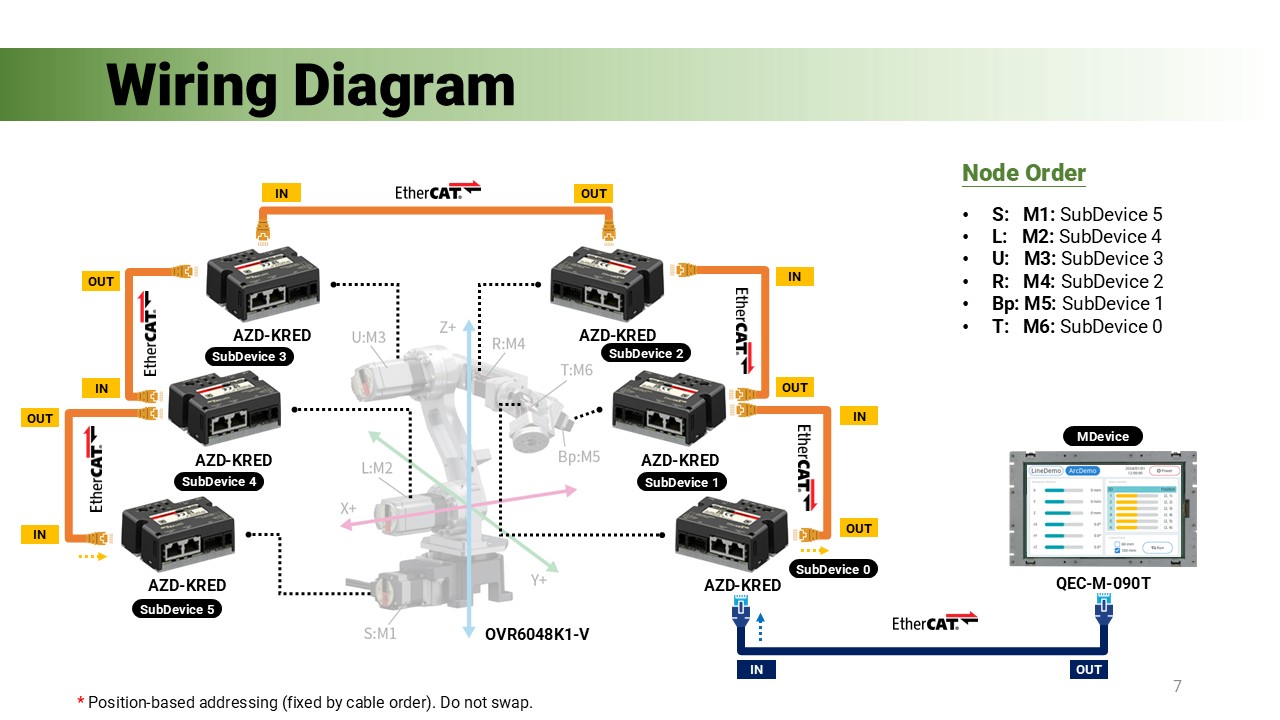
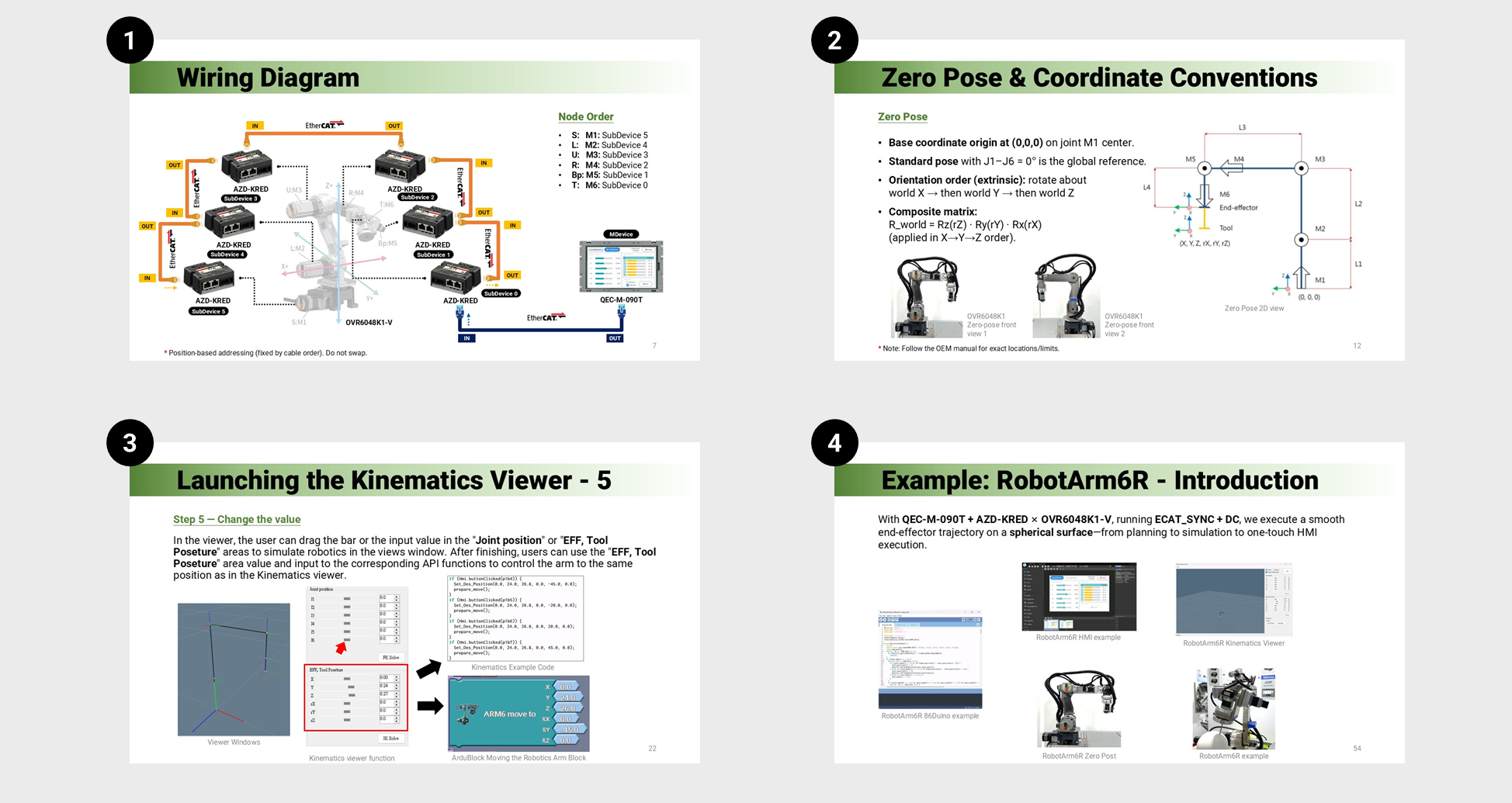
    The officially recommended node order and wiring topology are fully visualized. Axis swapping is prohibited to ensure consistent SubDevice ↔ axis mapping. Documentation includes Zero Pose definitions, axis resolution, and motion limits, significantly reducing first-time integration risks.
    OVR_Demo-5
  • Three Engineering Building Blocks
    1. Motion86 API / ArduBlock Blocks
      Minimal viable straight-line and circular motion, homing control, stop logic, and state-machine encapsulation. Engineers can prototype using blocks first, then transition seamlessly to APIs.
      ardu-10
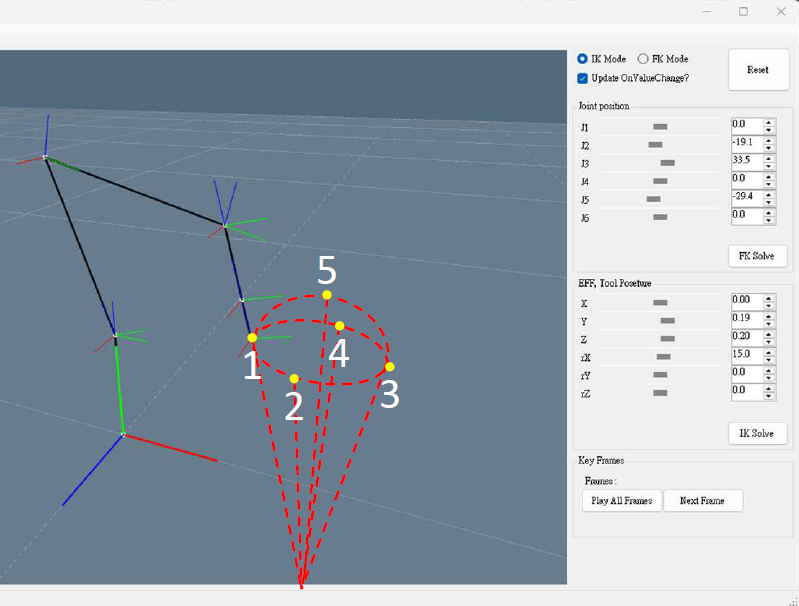
    2. Kinematics Viewer
      Visualization of FK/IK, reachable workspace, and singularities.
      Supports path file loading, point-by-point verification, and error prompts.
      Exports X, Y, Z, rX, rY, rZ parameters for one-click injection into the control layer.
      robotArm6R-1
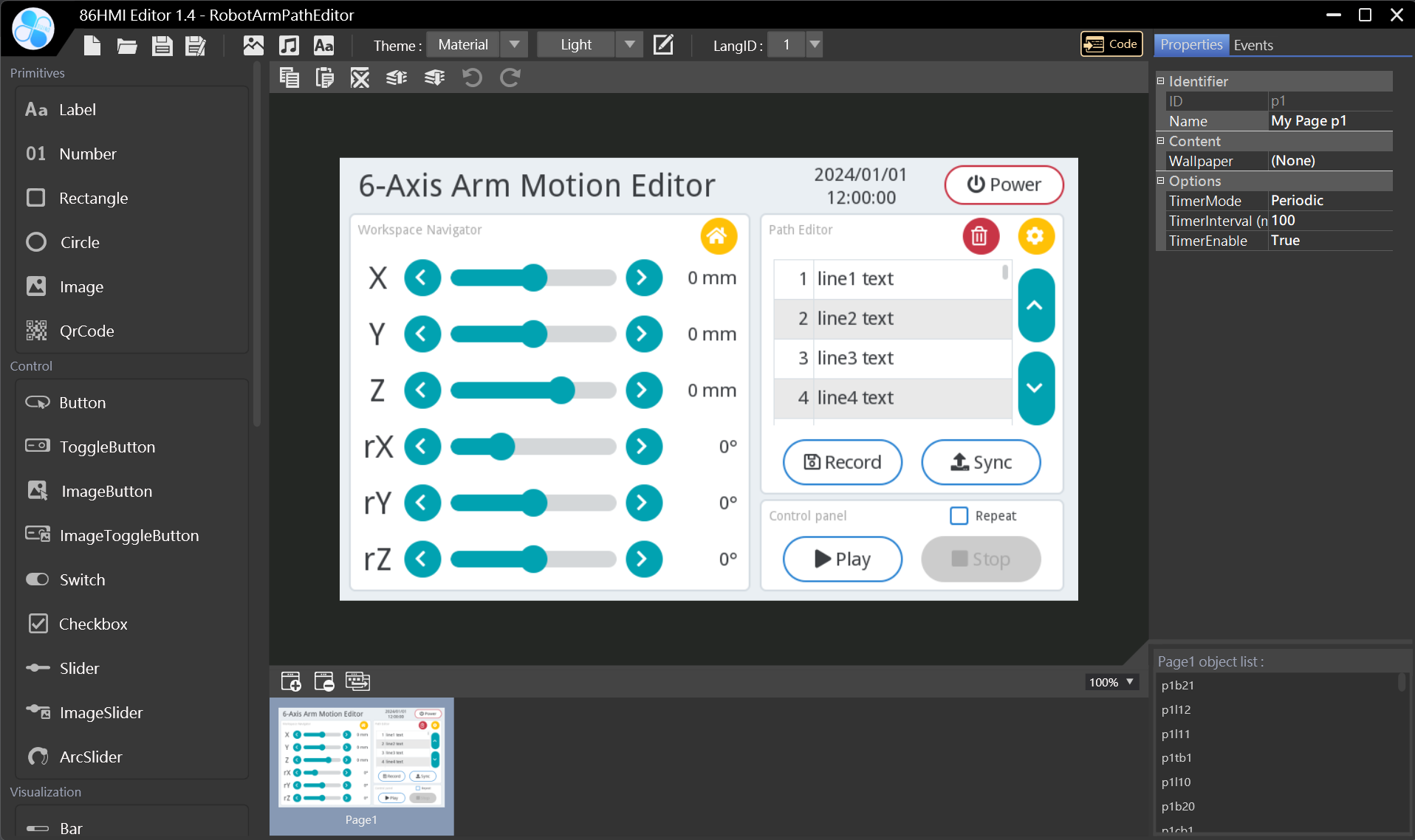
    3. LVGL / 86HMI
      Real-time display of robot posture, position, and alarms.
      The UI runs synchronously with the EtherCAT cycle, ensuring monitoring does not interfere with the control loop.
      OVR_HMI_Demo

Development Workflow: From FK / IK Validation to Motion Execution

At the software level, ICOP uses the 86Duino IDE (open-source, C/C++ architecture) as the primary development environment, establishing a reusable robot arm control workflow:

  1. Forward / Inverse Kinematics (FK / IK) Validation
    The robot kinematic model is validated at the system level to ensure accurate coordinate transformation and joint angle calculation.
  2. EtherCAT Motion Communication Integration
    Joint commands are synchronously distributed to all axes via EtherCAT, ensuring consistent multi-axis coordinated motion.
  3. HMI Integration and Status Monitoring
    Joint states, robot posture, and operation flows are integrated into the touchscreen interface for on-site operation and tuning.
  4. Record / Tune / Save / Play Workflow Design
    Supports motion recording, parameter tuning, and replay mechanisms, serving as essential tools for machine commissioning and application verification.

This workflow can be used as a standard development reference when deploying robot arm applications on equipment, reducing initial integration risks.

Quick Start & Download Resources

OVR_Demo-4

Technical Value for System Integrators and OEMs

Through this integration validation, ICOP demonstrates several practical advantages of the QEC EtherCAT MDevice platform in 6-axis robot arm applications:

  • Predictable real-time control behavior, suitable for synchronized multi-axis motion and complex trajectories
  • Simplified system architecture, integrating EtherCAT master, HMI, and motion control into a single industrial platform
  • Open development environment, enabling efficient secondary development and customization by system integrators
  • Equipment-oriented deployment, validated on real machines rather than limited to laboratory demonstrations

This architecture is particularly suitable for machine builders and system integrators who have adopted - or are evaluating - the Oriental Motor OVR 6-axis robot arm and wish to retain full control over the motion and application layers.


Toward Future Collaboration

ICOP will continue to build on the QEC EtherCAT platform to deepen technical integration with robot arms and motor solutions provided by Oriental Motor, and to offer:

  • Technical exchange on OVR robot arm control architectures
  • EtherCAT system design consulting for robot arm applications
  • Project-oriented validation and co-development discussions

Through closer technical collaboration, ICOP aims to help customers shorten development cycles and expand the deployment of robot arm applications in industrial equipment.


About Oriental Motor

Oriental Motor provides a wide range of industrial motion products, including stepper motors, servo systems, drivers, and robotic solutions for diverse automation applications.
More information: Oriental Motor Website

logo_orientalmotor

If you are planning to deploy — or have already deployed — the Oriental Motor OVR 6-axis robot arm and would like to further explore EtherCAT-based control architectures and development workflows, please contact ICOP for technical discussions and project consultation.

For more information and sample request, please write to info@icop.com.tw, call your nearest ICOP Branch, or contact our Worldwide Official Distributor.

Δ